Welcome to my ramblings...


Come with me as I travel through the real places of my life and into the steep, switch-back roads of the imagination. Join me. You'll be good company and your thoughts are welcome.
Showing posts with label pottery. Show all posts

Wednesday, May 18, 2016

History and Culture in Guanajuato City, Mexico


Guanajuato City in central Mexico was named a "World Heritage City" in 1988. Its colorful personality is like vivid gemstones fused through centuries of geo-political heat and pressure.


Its name is from an early indigenous language, “Quanax huato," which means “hilly place of frogs." 


Frogs are not as common as they used to be, nor are the metals, including silver and gold (lead, copper, iron, tin, and mercury) that drew miners.

The first people known to live here were the Otomi and they called it Mo-o-mi, "the place of metals." Legend suggests that the area was so rich in minerals that, at one time, gold rocks could be picked up off the ground.


Layered with colorful tradition and violent history, Mexican culture has evolved over the last five hundred years creating a unique blend of Native American and European that we know as modern-day Mexican.


The resulting architecture, art, food and drink as well as religion, music and dance beautifully illustrate this blend.


In Pre-Columbian times, the central plateau of Meso-America held numerous nomadic tribes with areas devoted to agriculture. Toltecs and Aztecs knew metal-working and used gold, silver and copper to create ornamentation for their elite as well and ceremonial pieces, as well as practical tools. Other common materials included jade, feathers, stone and clay.

Aztec clay creations


An Invasion


After Hernan Cortez destroyed the Aztec nation around 1520, a rapid influx of Europeans to "New Spain" caused turmoil and tragedy. Silver was discovered in the mountains surrounding the Guanajuato River Valley in 1546. The news in Spain: "God has blessed us with riches."


illustration from:  The Silver Industry of Mexico

Four mines were started in the hills and Haciendas were built along the river with many acres devoted to metal working. Hacienda managers were sent to run the haciendas and to assure that the owners paid the proper taxes to the government. Priests were sent by the Catholic Church to make sure the hacienda gave the appropriate tithes. 


Ex-Hacienda San Gabriel de Barrera 


Indigenous people were captured from surrounding areas and forced to work the mines. The oak forests that once covered the Sierra Guanajuato were cut down and burned as fuel. 

Because mercury, used to extract the silver from its native earthbound form is poisonous, and the mining shafts were dangerous, indigenous slaves had a short life-expectancy. The population declined rapidly.


Photograph from The Silver Industry in Mexico

By controlling the flow of water and its availability for irrigation, the Spanish hacienda managers controlled farming and indigents were forced into working for the crown. Since the heart of the town is at the bottom of a ravine between mountains, it is not surprising that flooding caused devastating damage to the settlement. Eventually, a tunnel was dug by miners to subvert the river underground. After this, the town developed over the river.

Spanish merchants grew rich from trading in silver. An underground market developed in Manila and merchants hid parts of the cargo, avoiding taxes and hoarding the extraneous trading.


Hacienda Business Counsel Room


Private Chapel brought from the cathedral in Jaen, Spain and reinstalled at Hacienda San Gabriel de Barrera

An Uprising


The Spanish-born upper class lived in opulence, but not all of them approved of the poor treatment of indigenous people. An exquisite history museum, the Alhóndiga de Granaditas in the heart of Guanajuato tells the story of those who rose up to speak out and fight for the workers.


Alhóndiga de Granaditas
The building itself is a monument to the struggle between insurgent natives and mestizos and the ruling class from Imperial Spain. Originally a Spanish-owned granary, it became a fortress where Spanish loyalists hid in fear of rebels.

Catholic Priest Miguel Hidalgo, (Father of the Mexican fight for Independence) joined with Ignacio Allende, Juan Aldama, and José Mariano Jiménez to oust Juan Antonio de Riaño y Bárcena, the ranking Spanish officer at the Alhóndiga.

Depiction of Miguel Hidalgo by José Chávez Morado

Juan José de los Reyes Martínez, "El Pípila," a strong local miner tied a large flat stone to his back to protect himself from rocks thrown down to kill him and spread petroleum on the wooden door and lit it using a torch. After the door burned, the insurgents stormed into the Alhóndiga. The people hiding there, many of them Spanish families from the outskirts of the city, were murdered.

Mural by José Chávez Morado

The four leaders of the fight (Hidalgo, Allende, Aldama and Jiménez,) determined to oust all the Spanish from Mexico, were later captured and beheaded. The four heads were displayed on metal forms shaped like birdcages from the corners of the Alhóndiga to discourage other independence movements. The heads remained there for ten years, until Mexico finally gained independence on September 28, 1821. 


Mexican Mix


Now, this town is rich with color and personality, gifted with fight and spirit. Now the battles are against drugs and government corruption. These demons continue to hinder the country, but the culture blossoms, wanting to thrive. The city is filled with students to keep the vibe young and with hard-working citizens who strive for a good life. The arts are alive. Beautiful city parks and fountains, quaint neighborhoods, and gardens invite tourists to enjoy a leisurely stroll. The food is outstanding.
Theater Juarez for the Performing Arts


City Monument


Neighborhood Plaza with Fountain Surrounded by Shops and Restaurants


Beautiful 3-Story Guest Home

Artist Diego Rivera grew up in Guanajuato and his childhood home is now a museum filled with his artwork and memories.


Fountain in Childhood home of Diego Rivera, Guanajuato
Flower Seller by Diego Rivera
"Flower Seller" painting of Diego Rivera, 1941


Underground Road System


The Guanajuato River has been redirected by tunnels under the city since the days of silver mining. And, since 1980, by continuing to tunnel under the city, a complete network of underground roads have been completed.
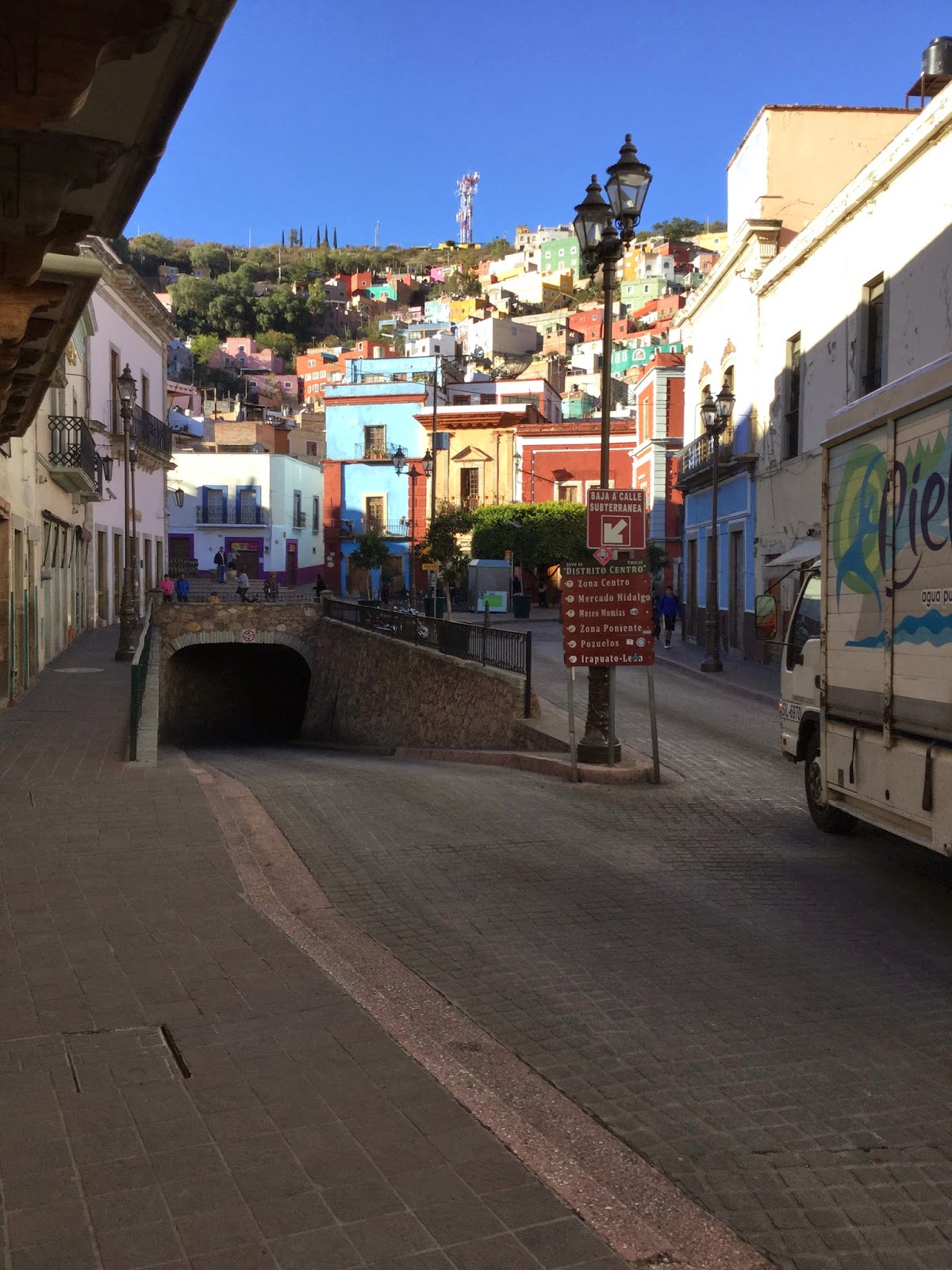
Entry to Underground Street System.


Some Good Old Stories


One of the most bizarre attractions in Guanajuato is the The Mummy Museum. The mummified bodies of ordinary citizens buried between 1850 and 1950 were disinterred for purposes of freeing up space and for collecting taxes. Bodies were preserved (mummified) by the natural elements in the ground, but if a family wanted a relative to remain buried, they came up with the tax money. Otherwise, the relative was dug and stored in a more efficient way--in a warehouse. Eventually, because folks were so curious about the bodies, and so many came to see them, officials began to charge for visits, Many took parts of the mummies as souvenirs or relics. Finally, the Museum was created for preserving the phenomenal. Visual artists in this region frequently include skeletons and mummies in their designs.


A glass case separates visitors from one of the mummy exhibits on display during a 2003 visit to the mummy museum in Guanajuato, Mexico. (Chicago Tribune/Terrence Antonio James)

Another must-see is the Don Quixote Museum. A vast art collection in a modest building (free to the public on Tuesdays) pays tribute to the literary character created by Miguel de Cervantes Saavedra in Spain and published in 1605.


The city has its own monument to Don Quixote and his loyal Sancho Panza as well as an annual festival with music, theater and opera: International Cervantino Festival.


Sancho Panza & Don Quixote at plaza Teatro Cervantes


The Festival Cervantino is in October. Can't think of a better time or reason to go see Guanajuato.


Wednesday, January 4, 2012

Excerpt from Spanish Doors, a novel.....

After the ceremony, they walked as a group back to Gramma’s where her neighbors and friends gathered and reminisced for most of the afternoon. They were an artsy bunch—old men with long, graying hair pulled back in ponytails, women in flowing colorful smocks and sandals with socks. Her house overflowed with food, which they ate together as one friend strummed his guitar and others sang. Rounds of rowdy laughter came from a group huddled around Kaira’s photograph albums, giving Arden reason to smile.

Stephen expressed a particular interest in the china cabinet and the clay pitchers Kaira had collected over the years. “I’m a potter myself,” he explained.

Arden opened its double doors to show him Gramma’s unique collection. “Every one of them is handmade,” she said, lifting the smallest and recalling when it was purchased after watching a potter at work in Williamsburg. She replaced it and asked, “Do you use a wheel?”

Stephen nodded, his lips twitching toward a smile, which he covered with the back of his hand.

Arden noticed the perfect line of his nose, his broad, strong chin and, when he dropped his hand to take the pitcher she handed him, his even white teeth. “What’s the grin about?”

“I don’t know,” he said, hiking his shoulders. “I like to make one-of-a-kind things you might put on a mantle.”

“You’re an artist then, “Arden guessed. “Like Gramma.” His sensual hands turned Gramma’s pitcher, and it occurred to her that he might be gay. “You live with Bernie Jacobs, don’t you?”

“Yes, and Anna Robertson,” he added, exchanging one pitcher for another. “The Catholic Church bought the house from someone who had a kiln out back, something Bernie and Anna have no interest in, but it seemed to be just waiting for me.” He lifted an eyebrow. “Synchronicity, I like to call it. We worked out a housing deal, rent-free for services. For me, that means encounter groups and youth groups. We hold meetings in the studio, which forces me to keep it clean.” He raised his eyebrows and took out another glass piece that seemed out of place in Gramma’s collection. “What’s this?”

“It’s a porrón,” she remembered, “for sharing wine.”

Made in Spain of blown glass, it had a long spout pulled from a rounded base to the full height of the vessel for dispensing, and there was a corked opening at the top for filling it. Surprised that she remembered the name for it, Arden said, “I always thought it looked like part of a chemistry set.” A mental picture of her father teased her then, his head thrown back, neck arched and mouth open, while he poured wine in a stream down his throat and swallowed both rhythmically and effortlessly.

At the sink, she removed the stopper and filled it with water. “Like this,” she said, lifting the porrón over her face at arms’ length. She aimed its spout carefully at the back of her open mouth so that the rush of water filled her throat and shut down all attempts to swallow. She choked and water rushed over her face, laughter gurgling in her throat. She dropped her head over the sink, coughing, to recover.

Stephen laughed and pulled paper towels for her to dry her face.

“Whew,” she said, sucking in air. “It takes practice.” She handed him the porrón, saying, “Here you try,” trading it for more paper towels and wiping at her face and the front of her blouse.

“Later,” he said, grinning and setting it aside.

“Come on, try it.”

“I’d rather try with wine,” he said.

“That’s fine,” she said.

“No, I’d rather just drink some wine. Why don’t I go out and buy us a bottle?”

“There’s some here,” she said, nodding toward a small wine rack and pointing to the cabinet above it, which held the glasses. “She keeps a corkscrew—kept a corkscrew—in the right top drawer.”

“You have some too?”

“Rioja,” she said, “near the bottom.”

After selecting a bottle of Rioja, he uncorked it and poured.

Arden savored a mouthful, rolling it over her tongue, feeling its silkiness, noting its light fruit. She swallowed, eyes closed, feeling Gramma’s presence as if she shared the moment.

Stephen inhaled the bouquet, then tasted. “Very nice.” He set down his glass and went back to examining clay pitchers, seemingly self-conscious about her eyes on his hands. “Caused by an iron,” he explained. “Happened when I was a toddler.”

Arden shook her head, regretting that she had noticed. “I’m sorry.”

“I reached up on the ironing board,” he said, “and when the iron fell on my hand, I couldn’t get it out.”

“How painful.” Arden winced. “Where was your mother?”

“Running to save me. She spent the Fourth of July in the hospital with me, both of us sedated, she says.”

“Does it bother you still?”

“Only this one nail catches on fabrics and sometimes scratches the slip as I shape my pottery.” He showed her.

 Arden felt comfortable with Stephen. He had a way of putting her at ease, and she liked that.  “When can I see your work?”

“Soon,” he said, abruptly bringing her back to Gramma. “Did you look for letters in the back of the cabinet?”

“There aren’t any letters! The drawers are full of linens and flatware. I’ll show you.” Bending over and sliding out the bottom drawer, she showed him, “Tablecloths and dresser scarves.”

“Don’t,” he protested her reaction.

“Middle drawer,” she continued, “place mats, napkin rings, napkins.”

“You don’t have to prove it to me,” he said.

“I’ll prove it to myself, then. If there are letters here, I want to know it. Top drawer: flatware, same as always. I don’t think there was anything to what she said in the hospital. I think she was incoherent due to the brain injury.”

Stephen studied the side of the cabinet. “Wonder why the top drawer isn’t as deep as the lower two?” He fingered the upper side panel and traced a hinge at the rear. “See this?” Under the pressure of his fingertips, as he moved them along the panel toward a midline crack, the panel nudged.

Arden was transfixed by his fingers on the curious panel, one she now observed in a new way. The possibility that Gramma had kept something private hidden in this cabinet—which was so familiar—was unsettling.

Having no drawer pull or knob, the panel gave no clues as to how it might open, but Stephen fumbled at pushing and pulling and attempted to tease it out with a fingernail. Then he unfolded his pocket-knife and offered it to Arden.

“Should I?”

“Why not? What if there’s really something here she wants you to find? I have a hunch there is.”

With apprehension, she handed the knife back. “You try,” she said. “Do you mind?”

He took it and slipped the blade into the panel and teased it out.

A gasp escaped Arden’s lips as she inserted a finger and swung it open. Hinged back all the way to the wall like a fan was a quarter-circle drawer stuffed with paper, dozens of thin pages of airmail stationery.

“Letters,” she mumbled.

All were hand-written in a script that tilted slightly left of vertical with a frequent dramatic flourish. A long oval Q began the address, “Querida Mami,” and, in closing, a thin pointed A to begin the signature “Alvaro.”

  “My father.” Tearing, her eyes met Stephen’s. His glittered with satisfaction. “You were right,” she said.

As she fumbled through pages, she noticed a date, and her heart raced. She held it out for Stephen to read.

“The fifteenth of February, this year,” he said. “Last month.

“Last month,” Arden repeated.

“There’s another panel on the other side. Should I open that one too?

“Yes.” Arden reeled with the implications.

“This is personal,” he said after opening a second drawer full of similar pages. “Maybe I should go.”

Stunned, she could only nod.

“You need some rest,” he said. “It’s been quite a day.”

Stone silent, she saw him to the door. “Goodnight,” she managed, and, “Thanks.” He gave her a quick hug and left.


Books available at...http://www.createspace.com/3448218